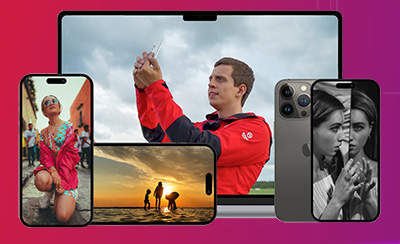







Best Lenses for Podcasts and Talking Head Video
Discover the best lenses for podcasts, including optimal lenses to use for a range of podcast setups, like talking-head framing and multi-host angles.
Camera Gear Guides | Lens Guides | By Jeff Collier | Last Updated: April 21, 2026
Shotkit may earn a commission on affiliate links. Learn more.
Podcasts are all the rage right now, but they’ve slowly transitioned from a purely audio format into an audio-video mix.
Indeed, many of the world’s most popular podcasts are now available in video format, transforming the entire medium into something more engaging and entertaining for audiences.
If you want to capture and convey your own podcasts in video form, the best lenses for podcasts will help enormously. It’s vital to choose a lens that fits your podcast’s format, whether it’s a solo-host, talking-head situation or a multiple-host setup.
In this guide, I’ll share my recommendations of five of the best podcast lenses to use, with a good mixture of options for those with different budgets and needs.
The 5 Best Lenses for Podcasts
Here are five of my favorite lenses for podcasts, including some of the best picks for podcasts with multiple hosts, solo hosts, interview-style situations, and more.
I’ve also made sure to include options at different price points, so even if you’re working with a slightly lower budget, you should be able to find a lens that meets your needs.
1. Sigma 16mm f/1.4 DC DN Contemporary Lens

- f/1.4 aperture provides brilliant background blur (bokeh)
- Wide-angle lens for tight spaces
- Good value for money
- May be some distortion when the subject is quite close to the camera
Let’s kick things off with one of my favorite lenses and a lens that often comes up when people ask for recommendations for filming their podcasts: the Sigma 16mm f/1.4 DC DN Contemporary lens.
Highly popular among the YouTube and content-creator crowd, this ultra-wide lens boasts a 16mm focal length, making it an excellent choice for smaller spaces, tight studios, or other podcast-filming setups where the camera needs to be quite close to the host.
The f/1.4 aperture of this lens also ensures that it works well in dimly-lit spaces, like bedrooms and home recording studios.
It lets plenty of light in while also creating a notably shallow depth of field and strong background blur, keeping the focus firmly on the person or people speaking.
For the price you pay for this lens, its image quality is excellent. Lines are sharp, and details are crisp, with no notable distortion that I've found – though some users have reported issues when using the lens close-up to their subjects or themselves.
The autofocus feature is quick and reliable, too, so even as positions change and people move around during recording, the focus should stay sharp and on-point for the full duration of your recording.
As a result, this is one of the top options to choose for solo talking head podcasts or multi-host setups in small spaces.
2. Sigma 18-50mm f/2.8 DC DN Contemporary Lens

- A broad zoom range for different setups and framing opportunities
- Good for solo or multi-host formats
- A compact and lightweight choice
- Doesn’t produce as much bokeh effect as other lenses
Next, I’m sticking with Sigma but looking at a very different and much more flexible type of lens: the Sigma 18-50mm f/2.8 DC DN Contemporary.
One of the most versatile options for APS-C mirrorless cameras, this lens can work for almost any podcast format.
That includes single-host setups where you simply want to position the camera a few feet away from you and talk right into it, as well as multi-host or interview/guest-based podcasts where you might want to adjust angles and positions as the podcast goes on.
The massive zoom range and broad focal length of this lens are the keys to its flexibility. It can handle any kind of shot, from wide shots that fit an entire desk into the frame to more focused, intimate framing situations.
The f/2.8 aperture ensures that no matter how much you zoom in or out, you will enjoy consistent quality, exposure, and a reasonable level of background blur.
It's worth noting, however, that the bokeh effect of this lens isn’t quite as noticeable or dramatic as it would be on faster prime lenses.
Another thing I like about this lens is its reasonably compact and lightweight nature. It won’t take up too much space in your camera bag and pairs nicely with smaller mirrorless cameras.
3. Sony FE 35mm f/1.8 Lens

- Produces very natural visuals that are easy on the eye
- f/1.8 aperture works well in low-light spaces
- Effective and reliable autofocus
- Not the most flexible due to its fixed focal length
Next, I’d like to focus on a lens that is one of the better options on the market today if you’re eager to film a solo talking-head podcast and get that stylish, almost cinematic level of quality you’d usually associate with famous YouTubers.
The Sony FE 35mm f/1.8 lens is a fantastic all-rounder, sitting in that sweet spot between “wide angle” and “portrait” lenses. It provides a really natural perspective, with absolutely minimal distortion, helping you capture videos that engage your audience and hold their attention for extended periods of time.
The f/1.8 aperture is also just right for creating a naturally shallow depth of field that can help you or any other subject you film stand out against the background of your studio setting.
Plus, even if your studio is a little on the dimmer side, the aperture should let in more than enough light to compensate.
Like the Sigma 18-50mm, this lens is also quite compact and lightweight, making it easy to carry around and place in position on typical tripods and stands. I adore this lens’s autofocus because it’s quiet, fast, and perfect for smooth and fluid movement in your videos.
The only real drawback worth mentioning with this lens is its fixed focal length, which does limit your options somewhat; you’ll have to actually move the camera to adjust framing, for example, instead of simply zooming in or out.
4. Canon RF 15-35mm f/2.8 L IS USM Lens

- High-end, professional-grade image quality
- A lens you can use for years
- Extremely versatile focal range
- By far one of the most expensive lenses on the list
Now we come to the most expensive lens on my list: the Canon RF 15-35mm f/2.8 L IS USM lens.
If you’re working with a smaller budget, this won’t be the lens for you, and it’s also not recommended for those making podcasts as merely a hobby or side project.
If, however, you have the additional funds to spend and want a lens that will elevate your podcast production quality to the highest levels, this could be the one you need.
It’s used by various professional podcasts and is extremely well-suited for studio-wide framing and multi-host setups.
This is due to its very versatile 15-35mm focal range, which makes it quite easy to capture a wide area of the studio without having to position your camera too far back. For example, it can capture three or even four hosts all sitting around a table together, and it’s also great for interview-style formats, too.
With its f/2.8 aperture, this lens delivers impressive exposure and appealing background blur on a consistent basis, even when zooming in quite close.
The built-in optical image stabilization is also a nice bonus if you’re shooting without a tripod or have to move the camera while filming.
As far as image quality is concerned, this Canon RF lens is exceptionally impressive, delivering crispness and clarity in even the finest details.
Really, the only downside is the price, which is admittedly quite high and will be beyond the budget of many amateur podcasters.
5. Canon RF 85mm f/2 Macro IS STM Lens

- More affordable than many other lenses
- Strong background blur for cinematic-style framing
- Great for close-ups or interview shots
- Long focal length means you need quite a lot of space between your camera and your subject
- Autofocus can be a little slow
I’ll finish up with something a little different: the Canon RF 85mm f/2 Macro IS STM lens.
It’s not like the others on this list, as it has a much longer focal length of 85mm, which is far higher than the 15-50mm range you’d usually expect in the best lenses for podcasts.
That focal length means that if you use this lens, you’ll most likely need to position your camera quite far back from your subject to capture them in the frame correctly.
As a result, you may not necessarily want to use the RF 85mm as your primary podcast lens. It can work really well on a secondary camera, providing tight, close-up shots of one of the hosts or an interview guest that you can cut to or edit into your final footage to give it more of a professional, polished vibe.
With built-in optical image stabilization, plus 0.5x macro capabilities, this lens brings a lot to the table at a relatively fair price point.
It may be awkward to set up in small spaces, but if you’ve got a slightly larger recording area, it’s certainly worth considering as a secondary or portrait-style lens.
Best Podcast Lenses: FAQs
What focal length is best for filming a podcast?
There’s no single “best focal length” for filming podcasts, as it all depends on your specific setup, the size of your studio, and the number of hosts you want to capture at any one time. For a solo, talking-head podcast, for example, focal lengths from 30mm to 50mm work well, keeping the focus firmly on the host without distorting the image. Wider-angle lenses, like 16mm to 24mm, do well in smaller spaces or when you want to incorporate more of the studio in the frame.
Is a prime lens or a zoom lens best for podcasts?
Both types can work well, but one may be better-suited to your specific podcast setup than the other. A prime lens will usually give you a wider aperture, which can help provide additional background blur that often works well for single-host podcasts. Zoom lenses are more flexible, as you can adjust the focal length without having to actually reposition the camera; they’re good for multi-host podcasts.
What lens is best for a two-person podcast setup?
For a two-person podcast, the ideal lens will depend on your exact studio setup, but in general, wide-angle lenses with focal lengths between 16mm and 24mm tend to work very well. They allow you to position both of your hosts comfortably around a desk or table and fit them both in the frame without having to move the camera too far back. The Sigma 18-50mm f/2.8 is a great choice for this, as is the Canon RF 15-35mm.
How far should the camera be from the host when filming a podcast?
There’s no specific rule about how far away you have to position your camera when filming a podcast, as it depends on how big your recording room is and how much you want to fit into the frame. If you’re using a wide-angle lens, you can usually put the camera just a few feet away and still capture everything quite nicely. For lenses in the 35 to 50mm range, or above, it’s best to place them a little further back.
Do I need multiple cameras for a video podcast?
Not necessarily, but it depends on how many hosts you have and what kind of video you want to produce. Some podcasts with large studios and lots of hosts/guests may incorporate multiple cameras so they can switch angles on the fly and focus on different people as they speak. Many, however, function just fine with a single camera setup, and it’s much cheaper this way, too.
What are the benefits of filming my podcasts?
Filming your podcast can help in terms of marketing it on more platforms, reaching a wider audience, and engaging your audience more effectively, too. A lot of podcast hosts have found that sharing video clips or full visual recordings of their podcasts can help them reach people who might find the usual audio-only format a little bland.
What other equipment do you need to film a podcast?
You don’t necessarily need too much gear to film a podcast, but if you’re willing to invest in some extra accessories, it will improve the quality of your captures. You’ll need decent-quality microphones to capture the audio, for example, and some LED or studio lights can help to brighten up the scene, especially if you’re in a small studio space. Mounts and tripods also help, along with soundproofing tiles and acoustic equipment to minimize echo and reverb around the room.
Jeff Collier is an experienced film photographer who enjoys experimenting with modern digital photography equipment, software and apps. He’s also an ex-world champion triathlete and avid cyclist, clocking hundreds of km each week in the beautiful Tweed Valley of northern NSW, Australia.
👋 WELCOME TO SHOTKIT!
🔥 Popular NOW: