







10 Seated Chair Poses That Make Female Executives Look Powerful
Create impactful corporate shots and LinkedIn profile images with these seated poses for women in the executive suite.
Learn | Posing | By Jeff Collier | Last Updated: October 14, 2026
Shotkit may earn a commission on affiliate links. Learn more.
If you’ve been hired to take corporate photos, this is the guide for you. I’m drawing on my experience working with women executives to help them look competent and confident in their professional photos and LinkedIn profile pictures.
Seated poses are accessible because most people can try them comfortably. They’re also useful for answering the age-old question, “What do I do with my hands?” – a common concern in portrait photography, including standing shots.
When a woman is seated, she may find it easier to rest her hands in her lap or place them on her knees, giving her a comfortable starting point and reducing uncertainty about what to do with them.
Read on for poses and practical tips to help you create professional portraits that convey confidence, credibility, and approachability.
The Importance of Impactful Professional Photos for Women
Women in the boardroom are still not as common as their male counterparts. With that in mind, creating corporate photos that encourage viewers to take women seriously is an essential part of cementing women in the executive world.
That doesn’t mean that there’s no room for fun. Some power poses are deliberately a little tongue-in-cheek, and a smile doesn’t necessarily have to be unprofessional.
Women executives should be able to convey the same confidence and professionalism in corporate photos as their male colleagues. Appropriate clothing, effective lighting, and thoughtful posing can all help achieve this.
For more advice on creating great photos of women in the workplace, check out my tips for great female professional headshots, with useful examples.
1. On the Bench

Seated poses don’t have to take place on huge office chairs or at a boardroom table. A portrait of an executive on an outdoor bench can offer a glimpse of everyday life while showcasing her professional style in a less formal setting.
This pose is ideal for executives at creative companies who want a more whimsical professional shot. It may also be a nice, slightly humorous image for a lawyer who likes wordplay.
Rather than photographing her directly from the front, ask her to sit with her legs angled to one side.
Additionally, ask her to turn her head toward the camera, in the opposite direction from her legs. She can then look just past the camera to create the impression that she’s observing something in the distance.
They may be using a tablet, a laptop, or reading a report. The pose is a slight break from this task; a snapshot of a moment of thoughtful reflection.
2. Seated on a Stool
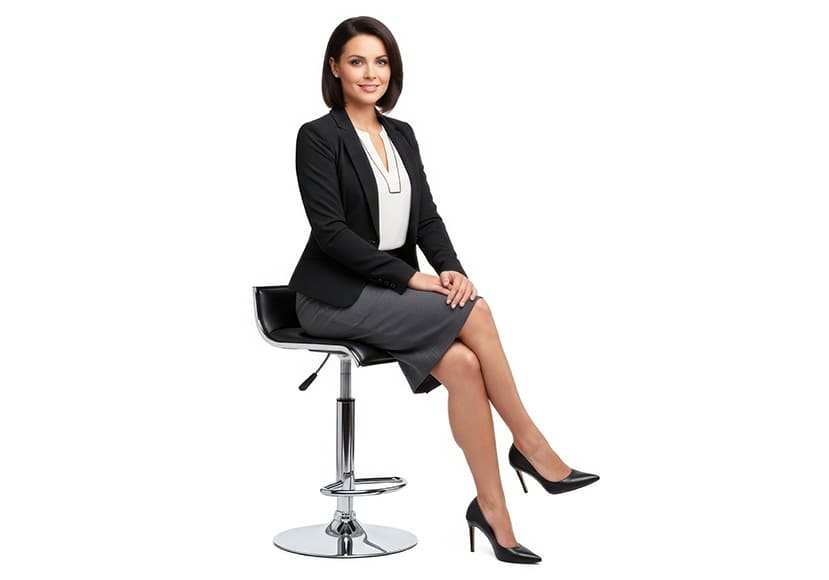
Many chairs have the problem that they don’t encourage a straight back. They can lead to executives inadvertently slumping or slouching, which doesn’t look very professional.
One way to combat this is to use an adjustable stool. The executive sits on the stool and consciously straightens her back, avoiding falling into the trap of letting a chair back shape her posture.
A cross-legged pose can work well for this, with her hands either in her lap or holding papers or a tablet. Try to discourage her from letting her arms fall straight down by her sides, as this will look strange and unnatural.
Position your client facing to one side, then have them turn to the camera. Try one smiling and one unsmiling to see which works best.
3. Hard at Work

Capture your client in her element as she works at her usual desk.
Try photographing the subject from slightly above eye level. This angle can change how her facial features appear in the frame and may help you work with the available light, depending on the setup.
It also creates the impression that she’s just turning to pay attention to someone visiting her at her desk. This makes this pose ideal for portraying an approachable manager or CEO, who always has her door open.
Try to ensure the desk is uncluttered and clean, or this will become the focal point of the image instead of your client.
4. Ready to Listen

Seated portraits don’t have to show the entire subject. Some clients may prefer a waist-up composition, depending on how they intend to use the images.
This particular pose is taken from directly in front of your subject, with them facing the camera and looking into it intently. Have them raise one hand under the chin to support the head.
The hand under the chin has the double impact of creating an attentive, listening pose associated with thoughtful, approachable managers. It also keeps the chin lifted and angular, sharpening the lines of the face.
Think about the setting for this picture. A large, empty boardroom may appear a little cold and unwelcoming.
Consider a cozier area of the workplace, or the team’s breakout area for a more relaxed vibe.
5. Taking a Break
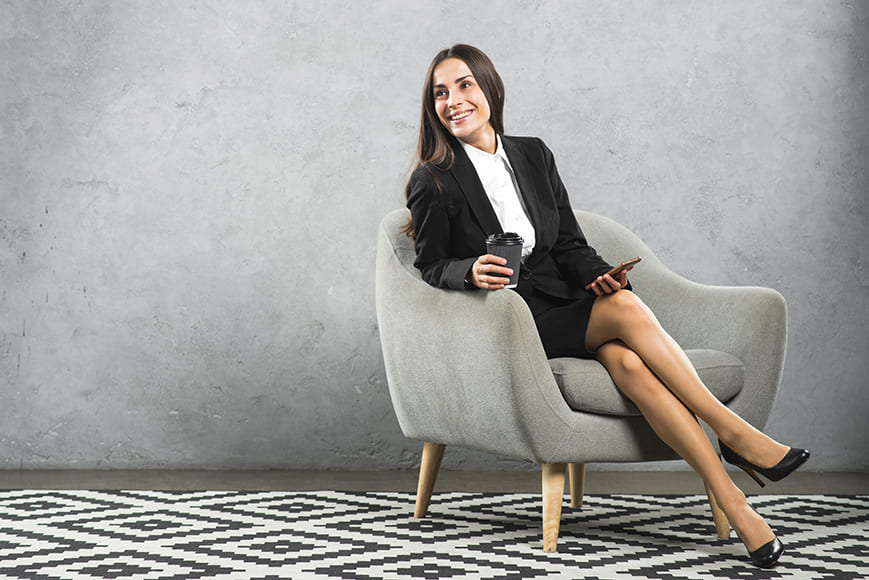
Everyone deserves a coffee break at work, even the boss. Capture your client relaxing in a comfortable chair, such as an armchair, with a coffee and her phone. The props can suggest a brief pause in a busy workday.
The contrast between a comfortable chair and professional clothing can give the image a relaxed but still work-appropriate feel.
Enhance that impression with a clear, uncluttered background and minimal props. Just a coffee and a tablet or smartphone complete this pose.
Have your subject look slightly to one side, as though she is speaking with a colleague. This pose can convey a relaxed, approachable professional taking a moment away from her desk.
6. Training the Team

Not all corporate photos have to be highly posed, single-person shots. An executive gets where she is because she leads, and that means actively speaking with and managing people.
See if you can get the chance to snap your subject when they’re in their element, presenting new information or techniques to a room full of eager listeners. These shots are ideal for corporate social media, professional networking, or even LinkedIn profile pictures, especially when someone is trying to highlight her strengths in the workplace.
Get behind the crowd and photograph your client through them. They should be slightly blurred, but she should remain in sharp focus. Where possible, get a shot of the content being presented, but if this isn’t possible, don’t worry.
The most important factor is that your subject looks confident and strong in her surroundings, ready to handle anything.
7. Absorbed in the Work

Some executives want their professional portraits to emphasize focus and dedication. If that suits your client’s personal brand, this pose can help communicate that impression.
Choose a chair that allows your subject to sit comfortably upright without restricting her movement.
If possible, position the subject near a window and photograph her in profile. Balance the exposure so that her facial features remain visible, even if the window is behind or to one side of her.
In environments where the ambient light won’t support this, consider light boxes or mounted lights to get the result you need.
The finishing touch is something your subject can focus on, such as a work tablet or laptop. Snap her in full work mode, committed to the task and determined to get it done.
8. Breaking Off to Speak to You

Executives are busy people, but the best ones always have time for their team members.
This pose can suggest that your subject has paused her work to speak with a colleague. Have her sit at her desk with a report, tablet, or laptop in front of her.
Ask her to turn her head toward the camera while keeping her torso angled slightly away from it.
Encourage a slight smile to reinforce the approachable energy of this pose.
9. The Interview Pose

Sometimes the most effective professional portrait is the simplest. This pose evokes a job interview, with the subject seated upright and looking toward the camera.
It’s a reminder that even executives and managers went through this too, and that everyone starts wherever they are via a similar process.
To create this feeling, seat your subject on a stool or straight-backed chair. There should be no opportunity for slouching or slumping.
She can cross her legs or not, depending on which makes her feel most confident. She should sit upright, look directly at the camera, and smile.
Experiment with the smile. Laughing might not be the best look, but if the smile is too small, it may seem lacking in confidence, so take several shots and compare them.
The contrast between the formal posing and the smile creates a pathway between interview nostalgia and present-day success.
As well as being a great professional profile pic, this pose is ideal for blogs about workplace promotions, guides on how to progress in the workplace, or even a biographic-style profile of the executive in question.
10. Leading the Presentation

An executive often has to present facts, figures, and reports to the rest of her team or to her direct reports. These presentations are an ideal opportunity to capture your client doing what they’re good at.
These images can work well for professional social media posts, networking content, corporate blogs, newsletters, and “meet the team” pages. They can also illustrate the executive’s role within the organization.
It’s okay to have other people in this shot. In fact, it helps showcase that your client is engaging effectively with others, one of the key expectations of most executives.
Check with your subject before photographing any presentation materials, and confirm that you have permission to include them in the final image. If the content is confidential or sensitive, change the framing, remove it from the scene, or blur it before publication.
Practical Tips for Corporate Photoshoots
Getting the pose right is probably the most critical part of a corporate photoshoot, in my opinion. But you can also use these tips to make things go more smoothly:
- Outfits: Encourage your clients to wear clothing that reflects what they would normally wear to work. If an outfit is stiff, tight, or uncomfortable, that discomfort may show in their posture or expression. Check the company’s dress code in advance, as expectations vary: some workplaces favor formal business attire, while others are more casual.
- Timing: Check that you’re booking the photoshoot at a time when your client is genuinely free. An hour spare between meetings might seem okay, but your client will be distracted, thinking about her next task.
- Communication: Listen to your client. She knows what’s comfortable and what’s not. You might think she looks great in a particular pose, but your client’s comfort and preferences should guide the final choice.
- Comparison: Look at other corporate photos from the same company, and ask your client what they want to emulate to fit in with the same ethos.
I think it’s always a good idea to try several poses and see which your client likes best. You can then try that pose from several different angles and with different lighting, to create a collection of usable images.
When you need to snap groups of professionals, check out my guide to posing employees for authentic brand photos.
Final Thoughts
Whether your client wants to use these shots on the company website or their own professional pages, like LinkedIn, it’s important that the photo portrays what they want it to.
Ask what vibe they’re hoping to give off with their image: serious, approachable, or competent. The answer to that question may determine exactly what poses you decide to use and the impact of the finished photos.

Check out these 8 essential tools to help you succeed as a professional photographer.
Includes limited-time discounts.
Jeff Collier is an experienced film photographer who enjoys experimenting with modern digital photography equipment, software and apps. He’s also an ex-world champion triathlete and avid cyclist, clocking hundreds of km each week in the beautiful Tweed Valley of northern NSW, Australia.
👋 WELCOME TO SHOTKIT!
🔥 Popular NOW: