






Top 6 Ultra-Lightweight Monopods for Wildlife Photography and Long Hikes
Discover six ultra-lightweight monopods for wildlife photography and hiking, with key specs, pros, cons, and tips for choosing the right one.
Camera Gear Guides | Tripod & Monopod Guides | By India Mantle | Last Updated: October 6, 2026
Shotkit may earn a commission on affiliate links. Learn more.
For wildlife photography or long hikes outdoors, a traditional tripod can require more setup and pack space than some photographers want to carry.
Instead, you need to snap photos on the go while still making the camera stable enough to capture a clear image. And that’s where a monopod shines.
But there are so many different monopods on the market, and some get excessively large to the point where they compete with tripods.
I’ve selected several excellent lightweight monopods for wildlife photography that might just become a core part of your camera gear the next time you go out.
What Are the Best Ultra-Lightweight Monopods for Wildlife Photography in 2026?
Most of the monopods here vary just slightly in terms of their actual weight, so the main determinant will be the additional features you might get from them.
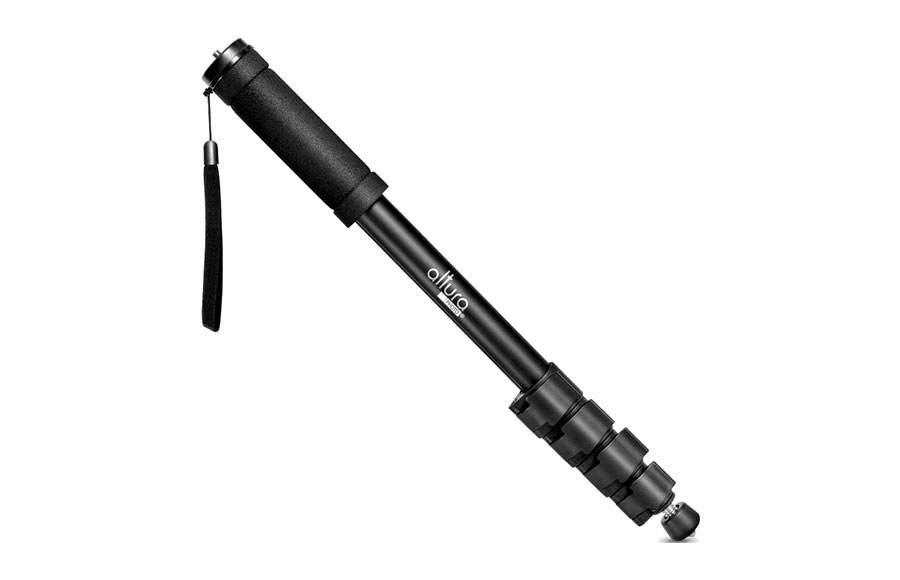
1. Altura Photo 62-Inch Camera Monopod – Most Lightweight Option
- Most lightweight
- Collapses to a small form factor
- Four-section collapsible leg
- Budget-friendly
- Small weight capacity
- Gets less stable at longer lengths
Weighing just under 0.6 pounds (at 0.59 to be exact), this is probably the least you can stretch the term “ultra-lightweight” while making sure the designation sticks. If you just need a monopod to provide a bit of stability and already have an overloaded gear bag, it’s likely going to be the go-to pick.
The leg houses a collapsible spike to ensure it digs into the ground to stay stable, while the foam grip and canvas strap add that extra bit of padding and security when you actually need to use the monopod.
The monopod itself extends to a respectable 62 inches in height and collapses to 16.75 inches, which means you have a solid range of options for snapping photos.
If there’s something to beware of here, it’s the low nominal 5-pound weight capacity. This is usually enough for a smaller mirrorless camera and a zoom lens, but a fully decked-out camera might be over its limits.
If you approach the weight limit, leave as much margin as possible, particularly with a large or front-heavy lens.
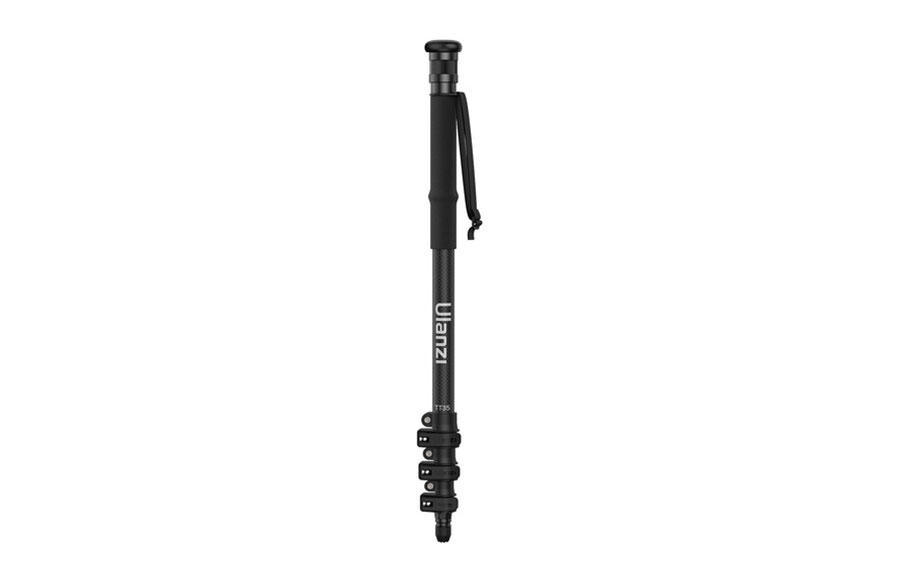
2. Ulanzi TT35 – Versatile Carbon Fiber Aluminum Mix
- Most lightweight carbon fiber option
- Four-section telescopic leg
- Respectable carrying capacity
- Part of a tripod kit
- Relatively low weight capacity
- Shorter telescoping with a longer collapsed length
If you don’t want an aluminum construction yet want to keep your monopod lightweight, the next option is the Ulanzi TT35. With only 9.7 oz (or just above 0.8 pounds) in weight, it’s one of the easiest monopods to slot into a bag.
The four-section leg allows the monopod to extend to a respectable 51.2 inches in height, making it a solid option when you want momentary support for your camera. It does collapse to just over 19 inches, so it might be a bit more cumbersome to fit inside the smallest carrying bags.
One of the main benefits of the Ulanzi TT35 is that it’s actually part of a tripod kit. Each “leg” of the tripod detaches to become a monopod of its own, and it comes with a small tripod base that provides additional stability when used as a single stick.
The 11-pound capacity listed for the TT35 kit refers to the ball head’s rated capacity, so it shouldn’t automatically be treated as the load rating of the individual monopod. So, avoid using a fully accessorized expensive camera with a large lens for it.
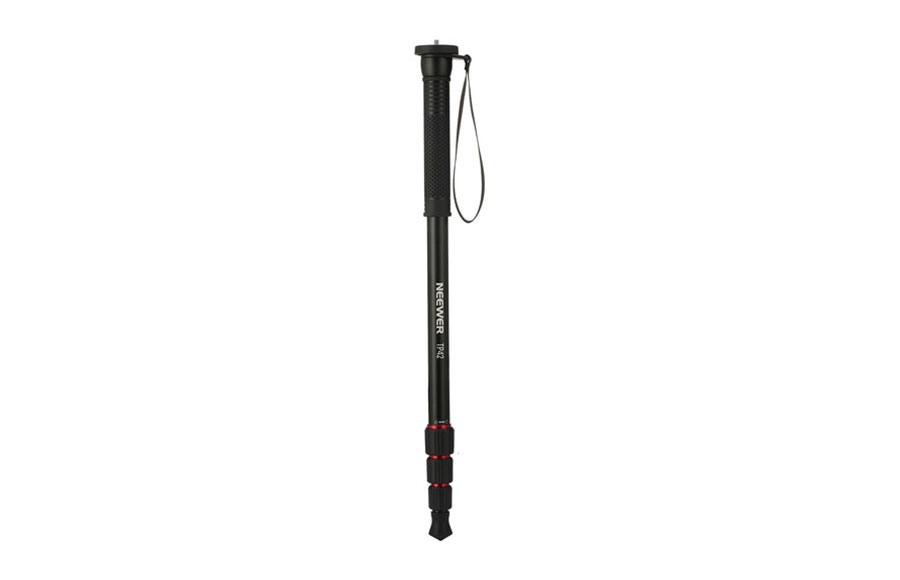
3. Neewer TP42 – Best Overall Hiking Option
- Durable aluminum body
- Extends up to 66.5 inches
- Interchangeable claw/padded base
- Comes with an 1/4 inch and 3/8 inch adapter
- Excellent weight capacity
- Collapsed length is large at 19 inches
- Not as “premium” as carbon fiber options
The Neewer TP42’s hallmark quality is the fact that it weighs only 1 pound while being able to support up to 22 pounds in weight. This allows it to fit most professional camera loadouts for something that’s easy to carry.
While it doesn’t have added leg support, it has an interchangeable feet system. You can fit it with a non-slip rubber pad for indoor use or rock, or a steel spike for grass or dirt surfaces, which means it can double as a small indoor mount.
The monopod is made from aluminum, and the four-part telescope allows it to extend up to 66.5 inches in height to provide a useful standing height for many wildlife photographers. It does come with its own carrying bag, which might be a necessity as its collapsed length is slightly longer at just over 19 inches.
4. SIRUI P-326 – Low-Noise Pick for Wildlife Photos
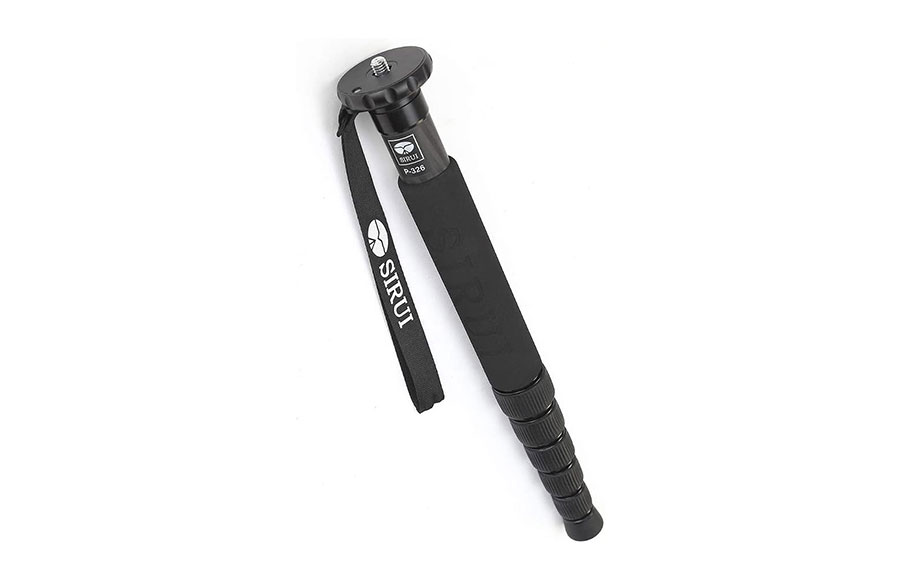
- Six-segment collapsible leg
- 8X carbon fiber construction
- Low-noise locking mechanism
- Retractable spike foot
- Lightweight with excellent carrying capacity
- Can flex if fully extended
- Less budget-friendly
If you need a monopod that’s purely designed to look and feel premium with sturdy construction, the SIRUI P-326 is it. It’s made from carbon fiber and engineered for quick snaps while taking up as little space and weight as possible, at only 0.9 pounds.
This is helped by the fact that the six-section monopod folds down to about 15.6 inches, with six segments, folding down to only 15.6 inches and extends to over 61.4 inches. The range should be enough to accommodate eye-level operation for most photographers if you find a slight elevation to put it on.
The monopod’s locking mechanism uses silicone twist locks, and they are made to be as quiet as possible. This can be a real boon for wildlife photography, where setting up the shot creates enough noise to send birds flying away.
One thing to note is that while the nominal weight capacity is 22 pounds (meaning it will support most cameras), the carbon fiber can flex when extended fully if you’re using a particularly large lens. If you spot flexing, retract the thinnest leg segment.
5. Gitzo GM2562T Series 2 – Most Compact Premium Pick
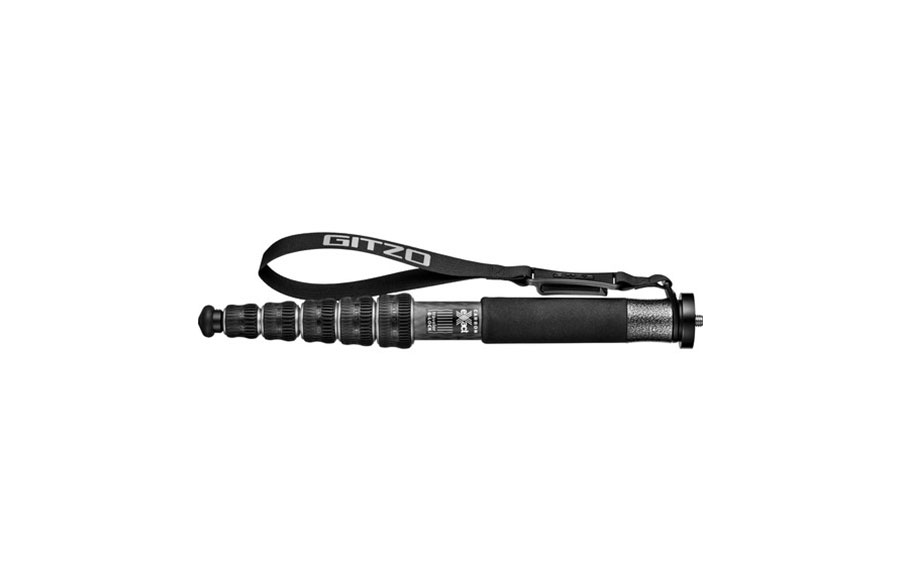
- Compact at only 14 inches folded
- Premium carbon eXact tubing build
- Extreme weight capacity at nearly 40 pounds
- Integrated bubble level indicator
- Clip-on strap for belts
- Not budget-friendly
- Non-interchangeable foot
If you want the most compact option in this roundup, then the Gitzo GM2562T Series 2 Traveler should be right up your alley. It collapses to just under 14.2 inches in length, while the six-segment leg allows it to extend to a respectable 55.9”, which also allows it to fit into a bag while still being able to be operated at near-eye level.
The premium Carbon eXact tubing means that this is the sturdiest and most robust option while weighing only 0.9 pounds. It also gives the monopod a ludicrous 39.7-pound weight capacity, so you can fit your most premium gear and not worry it will collapse on you.
To make the monopod easier to use, Gitzo has put in a clip in the strap that allows you to attach it to a belt or pocket. There’s even a bubble level indicator to ensure you have as stable a shot as you can from a monopod.
One of the main downsides of this model is that its base is a simple round-base foot that isn’t even compatible with other Gitzo mounting attachments. This can make it last a bit shorter in particularly bad weather and ground conditions.
6. Manfrotto Element MII – Best for Heavy Lenses on a Budget
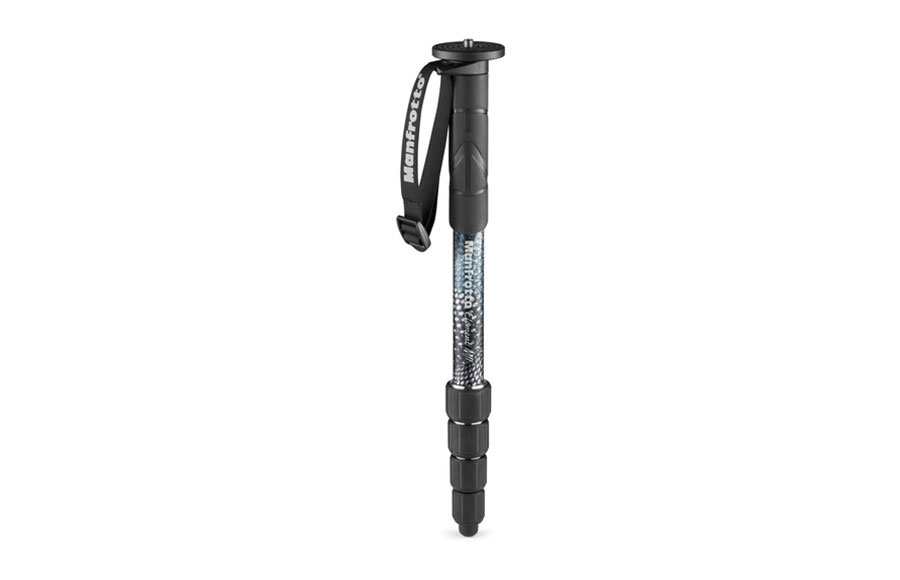
- Excellent weight capacity
- Durable aluminum build
- Ergonomic twist locks usable with gloves
- Good extension range
- Comparatively heavy for a monopod
- Doesn’t absorb vibrations as well
If you’ve used up most of your bag’s “carrying budget” on high-quality lenses, then you need something that balances lightweight, range of motion, and weight capacity. This is where Manfrotto’s Element MII monopod comes in with a 35.3-pound weight limit.
The carrying capacity like that is usually something you see in carbon fiber monopods (with a nearly premium price tag), making this a budget-friendly option for that purpose.
The monopod itself is slightly bulkier than ultra-lightweight, weighing around 1.1 pounds. Its five-section leg collapses to 16.9 inches and extends up to 62.6 inches, giving you a good range of operation to work with.
The aluminum build here helps the monopod stay stable when under load. However, it also means it’ll be cold to the touch in winter and might not absorb vibrations as well as carbon fiber, so you may need to take a bit more time to line up a shot.
Manfrotto itself is one of the most popular Italian brands when it comes to camera equipment, so you know you’re getting a good monopod at a reasonable price.
How to Choose the Right Ultra-Lightweight Monopod for Wildlife and Hiking
A monopod for long hikes has to balance three things that pull against each other: low weight, enough strength for your lens, and enough height to shoot comfortably. Start with your heaviest camera and lens combination, then decide how much weight and packed length you’re willing to carry.
How Light Should a Hiking Monopod Be?
For long hikes, aim for 1 pound or less. Everything in this guide falls around that mark except for the Manfrotto MII. However, length matters just as much as weight, because a monopod that collapses to 14 to 16 inches can ride in a side pocket, while a longer one has to be strapped to the outside of your pack where it can catch on branches or get dinged on rocks.
Carbon Fiber vs. Aluminum
Carbon fiber has a better strength-to-weight ratio. It also dampens vibration better, and it doesn’t feel as painfully cold to hold on winter mornings. If you hike often or shoot in cold weather, carbon fiber is worth the extra price tag.
How Much Load Capacity Do You Need?
When you add up your camera body, lens, and any head or plate, you should still leave a healthy margin. Choose a monopod whose rated load comfortably exceeds the total weight of your camera, lens, head, and plate – especially with long, front-heavy telephoto lenses – while a full-frame mirrorless camera with a 200–600mm-class lens can exceed 5 pounds, making a 5-pound-rated monopod unsuitable.
Twist Locks vs. Flip Locks
Twist locks are slim, snag-free, and usually quieter, which helps around skittish animals and in dense brush, while flip locks are faster to operate at a glance but can catch on vegetation. More sections make a monopod pack smaller but add more locks to open, so a six-section model trades a little setup speed for a shorter folded length.
Do You Need a Monopod Head for Wildlife Photography?
A tilt head adds some flexibility for vertical adjustments, but it also adds weight. If your lens has a rotating collar and foot, try shooting without a head first. You can usually twist the entire monopod around if you want a slightly different angle.
Can a Monopod Double as a Trekking Pole?
Some hybrid models are designed to double as trekking poles. Ordinary camera monopods are not necessarily designed to support a person’s body weight, so don’t use one as a trekking pole unless the manufacturer specifically says it is suitable for that purpose.
Quick Recommendations
- Lightest and cheapest option for small kits → Altura Photo 62-Inch Monopod
- Versatility for hiking, shooting, and kit overhaul to tripod → ULANZI TT35
- Most capacity per dollar for heavy telephotos → NEEWER TP42
- Proven premium carbon monopod → SIRUI P-326
- Smallest folded size and pro build quality → Gitzo GM2562T Series 2 Traveler
- Huge load rating from a major brand without carbon pricing → Manfrotto Element MII
FAQs
What is the lightest monopod for wildlife photography?
The Altura Photo 62-Inch Monopod is the lightest at about 0.59 pounds, but it’s also limited to 5 pounds of gear. For heavier setups, models such as the SIRUI P-326 and NEEWER TP42 are rated for up to 22 pounds.
Is a monopod better than a tripod for hiking wildlife photography?
A monopod is lighter, packs smaller, and sets up in seconds, so you can react when an animal appears. A tripod is more stable for long exposures and extended waits in one spot, but it’s much heavier to carry over long distances.
Is carbon fiber worth it for a hiking monopod?
If you hike often, shoot in cold conditions, or use heavy lenses, carbon fiber has a better strength-to-weight ratio and doesn’t conduct heat as much. For occasional use on short walks, a quality aluminum monopod does the job for less money.
How tall should a wildlife monopod be?
Ideally, it should bring your viewfinder to eye level while you stand, which usually means around 60 inches or more of maximum height for most adults. Shorter models like the Gitzo Traveler work well if you shoot seated, kneeling, or from a hide.

As the General Manager of Shotkit, India Mantle brings with her a lifelong love for photography that she developed during her childhood, watching her father document their family moments with his Nikon EM. In her free time, you find her enjoying the awe-inspiring natural beauty of her home, Northern Rivers, Australia.
👋 WELCOME TO SHOTKIT!
🔥 Popular NOW: