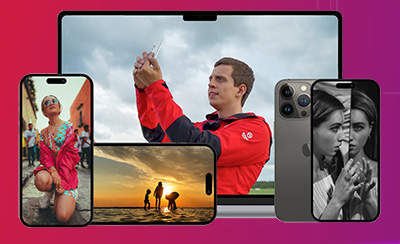







How to Perfect Your Selfies and Portraits With Facetune
Find out how Facetune’s features stack up for on-the-go photo editing, and how you can use it to perfect your selfies and portraits.
AI | Software | By India Mantle | Last Updated: December 5, 2025
Shotkit may earn a commission on affiliate links. Learn more.
I’ve typically found that if I want an excellent selfie, I need dedicated photography equipment and professional tools.
Simply using the phone’s camera can be hit-or-miss, especially when you’re working outside and have little control over the background lighting, objects, or even wind.
But for most users, phone apps are the only way to go, because who has a professional photographer on hand to take portraits when they're traveling?
You can simply snap a selfie, then use any of the myriad apps available on the Google Play Store or App Store to make light edits before posting.
The capabilities of these apps have also gone through the roof thanks to how good AI tools have become recently.
Even Facetune, which was one of the first big apps to hit the selfie-editing market over 10 years ago, has jumped on the AI train. I’ve been using the tool to glow up my selfies for ages, so using it with AI is a natural next step.
So let me give you a closer look at how Facetune can quickly become your best friend when you want studio-quality photos.
How to Get Started With Facetune
In general, using Facetune should be relatively easy if you’ve used a photo editing app before. The installation process is similar to most other phone apps.
But this is also perhaps one of the biggest downsides of the app: it only works on phones, unless you’re willing to use a virtual machine or emulator to get mobile apps on your computer.
I’ve found it slightly easier going to Facetune’s website on PC, completing the sign-up process there, and then getting a direct download link to the app.
The sign-up requires you to provide payment info, so keep that in mind when starting out.
Once you're done, you can simply open the app on your phone and allow it to access your files to get started.
Feature Review
Perhaps the best way to describe Facetune is “streamlined Photoshop.”
The tool presents you with options that detail what it’s trying to accomplish rather than what it’s doing in the background.
Combined with a solid UI, it will only take a few minutes to get started. The basic functions are so straightforward that you can get good results with only a few minutes of editing.
However, if you also want to go for professional-grade results, the app’s more advanced features can get you almost there.
Smoothing
If you’re having an off-day and your skin looks dry, flaky, or with blemishes, smoothing is likely the first function you’ll want to use (even if it’s tucked away a bit).
The tool has both an automatic and a manual smoothing mode, which allows you to directly adjust the areas of the face you’re working with.
One of the best things about auto-smoothing here is that it removes small blemishes or wrinkles without making you look fake.
Even when I put the dial to 100, some of the skin’s natural texture is still clearly visible, which ensures that you don’t look too artificial.

This can be more easily seen if you use the “before-and-after” preview on the bottom-right, especially if your selfie already has decent lighting.
Eye Brightening and Color Changes
This is likely one of the most underrated yet useful features of Facetune that works practically perfectly.
I’m not going to delve into changing the eye color, as the feature works well, but might not really be necessary. It can be fun to play around with, but ultimately doesn’t make your selfie better or worse.
However, changing or removing the reflections and increasing the contrast between your iris and the sclera (the white of the eye) can make the eyes appear younger and more energetic.
Unlike with smoothing, I’d advise you not to go to full 100 on the dial. Somewhere around 60 to 70 should generally do the trick.

Fixing Blemishes or Details
While smoothing can address general skin texture and appearance, it might not work on larger blemishes or details that deviate too much from the normal skin.
To fix that, you can use the “Vanish” tool (which takes a bit of scrolling through to find).
This works similarly to Photoshop’s healing brush. You can drag the tool over the portion of the image you want to fix and choose the “Heal” option.
Facetune will then apply the color that most closely approximates the rest of the face over the spot.
Alternatively, the “Vanish” option can be great if you want to remove details from the background. For my test image, I removed the painting in the background.
This is where you might need to perform a few different passes with the tool to get the results you want, as the AI might get it a bit wrong.
For example, when I didn’t put the entire frame in the outline, the painting itself was blurred. But when I did, the AI tried to approximate it somewhere between the floor and a wall, which led to odd results.


Teeth Whitening
While eyes are generally white and can be easier to fix with a bit of lighting, teeth can be notoriously difficult to photograph.
Luckily, Facetune has a solid teeth-whitening feature that has both an automatic and manual mode.
With the automatic mode, the AI will detect the teeth and whiten them all in one go for a slightly smoother finish. But in the manual mode, you can draw over specific sections, which allows you to get a more pronounced result.

As with the eye whitening, you don’t want to go all-in here. The automatic mode can be particularly notorious for this, as some pass-throughs left the teeth looking like an unsightly white block.
Adjusting Lighting and Backgrounds
This option can take a lot of time to get right if you’re working with suboptimal angles or lighting.
You can adjust the lighting before or after performing the face edits above. In general, most editors will agree that lighting corrections should be used before.
However, this is ultimately up to you. Some images can instantly get better with a slight lighting change, while others need more comprehensive edits to get the lighting fixed.
While you can get really in-depth with contrast, color saturation, and luminance, I’ve found it easier to use the preset Lighting options, especially “Studio” and “Blue.”
When using the presets, do note that the AI might take it a bit too far. I would advise not really going above 50 at all, as the image just looks a bit too fake past that point.


Background Changes
In most studio setups, you’ll quickly notice that the absence of a busy background creates a more professional look. Of course, this is the opposite of social media sites, which get more views with more dynamic posts.
As a result, blurring or changing the background to reduce the focus can dramatically improve the sharpness of your selfie without actually making any dramatic changes.
Two different sections will help you here: “Defocus” and “Backdrop.”
The Defocus section is great if you’ve got a background that is quite detailed by itself. It blurs the clutter to create the depth-of-field effect that you get with professional camera lenses.
Alternatively, if you want to edit your selfie without worrying about the background at all, use the app’s preset Backdrops feature.

As you can see, Facetune will automatically capture your details and cut them against the background. Bottom line, the AI cropper is among the most precise I’ve seen.
Just make sure to position the backdrop properly so it actually covers the entire background, or you might have pieces of the original visible from the sides.
The presets are a bit odd, to be honest, but there are plenty of options, including some relatively blank ones.
You can also use a custom photo from your gallery to serve as a backdrop, allowing you to pick and choose locations that work well with a travel journal, for example.
Skin and Look Changes
The AI also has a remarkable ability to detect the outlines of the face, such as cheeks, eyes, nose, and ears.
Then, by slightly changing the shape and size of some of these features, you can give the selfie an entirely different feel and tone.
The differences here can be incredibly subtle if you’re not paying attention. For best results, I’ve found that choosing a mode (such as “Gentle”) and dialing it up to 100 gives a good preview of what's being changed.
After that, dial it up and down to get a rough idea of which direction you want to go in.
Facetune only accepts one of the preset changes, but with half a dozen options available, you should be able to get a good result.


The app also technically separates the look changes by gender, but considers them more as suggestions rather than strict rules.
In a similar vein, the “Skin” section can automatically remove some blemishes, wrinkles, or reflections. It’s a good idea to try this over trying to manually pick and choose spots to enhance.
Styling Changes
Facetune is also great if you want to experiment with different hairstyles, cuts, eyebrows, beards, and even makeup.
I’ve found that these changes are relatively easy to make. For instance, beard styling (which is arguably the hardest to get right for AI editors since it needs to follow the face shape and contours) has worked generally well for some of the models I’ve put into the app.
Plus, if you actually do like a particular hairstyle but are afraid to make an actual long-term change, these options can give you that pop of color and style without actually committing.
There’s also an option that allows you to change clothes. In most cases, you will use either the preset Prints or the Custom option.
To accomplish this, the AI generally prints over the image. But it’s not completely foolproof. For some images, the printout went slightly off and printed on the skin itself.

Advanced Features
Beyond simply making changes to the image, Facetune has a slew of additional features that make the app easy to use and worth the investment.
Before-and-After Preview
This one is a literal lifesaver. That small button on the bottom-right allows you to temporarily undo a change and then redo it to see how it changes the original image, so you can be sure the change is one you want to make.
Additionally, once you actually save the image, Facetune can automatically generate a before-and-after shot to display the original and the edited side-by-side.
This has been great if I want to quickly edit a client’s image and show them a preview of how it can look with just a few small changes without permanently altering the original. Then, I can commit to making more substantial edits if needed.
Complete Editing History
While the UI doesn’t technically show it, Facetune stores the entire editing history of an image once you start working on it.
Then, you can simply use the Undo or Redo buttons to go through the changes you’ve made. It’s great if you want to start from a particular point and not have to redo a lot of small changes.
Also, the app’s homepage stores all the images you’ve saved to the device, including their editing histories. You can go back at any time and call up a past image if you want to make a quick edit to repost it to a different platform.
AI Model Training
Apart from image editing, Facetune also has image generation.
This is slightly different from traditional editing.
First, you’ll need to provide at least 10-15 different images of yourself, including those from slightly different angles. For these, it’s best to stick with a neutral background, but you can use Facetune to edit them beforehand.
Then, choose from the style you want, including business, studio, portrait, and even dating website shots. The AI will generate a small gallery of images that look like you in a professional-looking setting for any of the options.
Alternatively, you can use full-body shots and try on different clothes, outfits, or hairstyles. The outfit try-on requires higher-quality images of clothing and getting the right angle in the original photo.
Finally, Facetune can also be used to make image galleries of you or your family and place them in fantastical or studio settings. However, as with most personal photos, I can’t emphasize enough the need to be cautious about how you use this feature and where you post the images.
Best Practices for Using Facetune
While Facetune is technically easy to get into, mastering it can take quite a while, so take full advantage of the seven-day trial to test out the features. Here’s what I found to be particularly helpful.
Adjust your phone screen to maximum brightness. Some flaws are either not visible in low light or become inconsequential when you turn it up.
Use the zoom feature frequently. The AI capture can make mistakes, especially around the fine lines or borders between features (such as lips and eyelids). Zooming in allows you to immediately spot overcorrections.
Save multiple versions of the image. While the undo feature and history are neat, there are no options to compare two starkly different stages of editing side by side.
Avoid overediting. Some selfies look good even though they have a few flaws, and the time you need to achieve perfection might not be worth the effort.
Stick to solo shots. Group photos should generally be left to professional editors. This way, you avoid making too few or too many changes that can affect how everyone else looks by comparison.
The Ethical Side of Photo Editing
I think it’s important to talk about this.
There’s been a lot of discussion about how edited photos on social media affect self-esteem and create unrealistic beauty standards. I’m mindful of this when I edit my own photos, both for myself and clients.
My rule is simple: I only edit to correct mistakes or enhance what's already there. I don’t change my fundamental appearance, which is why I haven’t really discussed the app's features that allow you to make drastic changes to face shape or size.
Pricing
Last, I want to discuss one of the bigger downsides of the app: it’s not free.
As I mentioned, there’s a seven-day trial that allows you to use all the available tools, including the advanced AI generation. After that, you will be charged according to the payment info you submitted when you select a plan.
One workaround is to continuously make different accounts and use different cards for them, but at some point, that becomes unfeasible.
After that, your only real option is to purchase a subscription.
The monthly subscription for Facetune ($25) might be a bit steep for what the tool does, especially given that you can’t access it on PC, where you’d have more control and fine-tuning options.
The three-month and yearly subscriptions are better deals, with a price tag of $77.99 per year if you go for the latter.
Therefore, I’d recommend you pick a period where you have a bit of free time to practice using and experimenting with the tool extensively. Then, you can decide if you want to pay to keep using it or get a free alternative with a more limited suite of options.
Ultimately, Facetune is a really powerful tool, but it requires a bit of restraint to avoid going overboard with the edits and some practice to achieve truly excellent results. Both of those are up to you.

As the General Manager of Shotkit, India Mantle brings with her a lifelong love for photography that she developed during her childhood, watching her father document their family moments with his Nikon EM. In her free time, you find her enjoying the awe-inspiring natural beauty of her home, Northern Rivers, Australia.
👋 WELCOME TO SHOTKIT!
🔥 Popular NOW: