







We Asked 1,000 Photographers What Camera They Use (And the Results Surprised Us!)
Surprising results of a survey we conducted to discover what cameras professional and amateur photographers are using and why.
Learn | By Mark Condon | Last Updated: January 11, 2025
Shotkit may earn a commission on affiliate links. Learn more.
We recently surveyed 1,000 photographers to answer the question:
What camera do amateur and professional photographers use?
We also looked at whether photographers are using DSLRs or mirrorless cameras and the reasons for their choice.
What we uncovered surprised us, and today I'm going to share our findings with you.
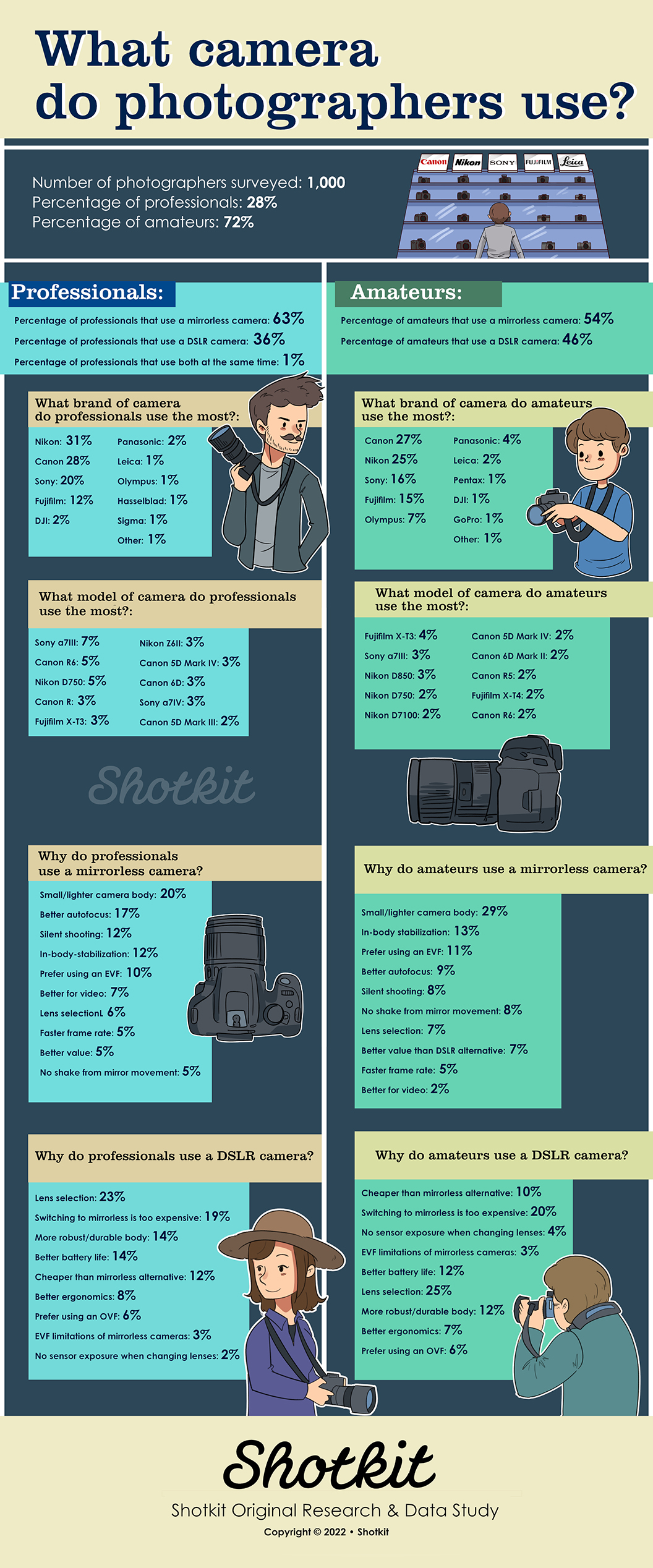
1. Mirrorless cameras are more popular than DSLR cameras for professional photographers. 63% of professional photographers use a mirrorless camera, while 36% of them use a DSLR camera. Only 1% use both.
2. Mirrorless cameras are more popular than DSLR cameras for amateur photographers too (but not by much). 54% of amateur photographers use a mirrorless camera, while 46% of them use a DSLR camera.
3. The most common reason why professional photographers use mirrorless cameras is that they are smaller and lighter. The second most common reason was that they offer better autofocus.
4. The most common reason why amateur photographers use mirrorless cameras is that they are smaller and lighter. The second most common reason was that they offer in-body stabilization.
5. Nikon is the most popular camera brand used by professional photographers. 31% of professionals use Nikon, closely followed by Canon (28%) and Sony (20%).
6. Canon is the most popular camera brand used by amateur photographers. 27% of amateurs use Canon, closely followed by Nikon (25%) and Sony (16%).
7. The Sony a7III is the most popular camera used by professional photographers. 7% of pros use the Sony a7III mirrorless camera, with the Canon R6 mirrorless camera and Nikon D750 DSLR camera coming in joint 2nd and 3rd.
8. The Alpha a7III and the Nikon D850 are the most popular cameras used by amateur photographers. One is a mirrorless camera and the other is a DSLR.
9. Professional photographers like to use the Sony a7III for their personal photography pursuits too. The Fujifilm X-T3 and Nikon D850 are also popular choices.
10. The most common reason why both amateur and professional photographers use DSLR cameras is due to the superior lens selection. The second most common reason was that switching to the mirrorless system is too expensive.
(Click to view larger)
Share this Image On Your Site by Copying the HTML Content Below:
Mirrorless Cameras are More Popular than DSLRs for Both Professional & Amateur Photographers
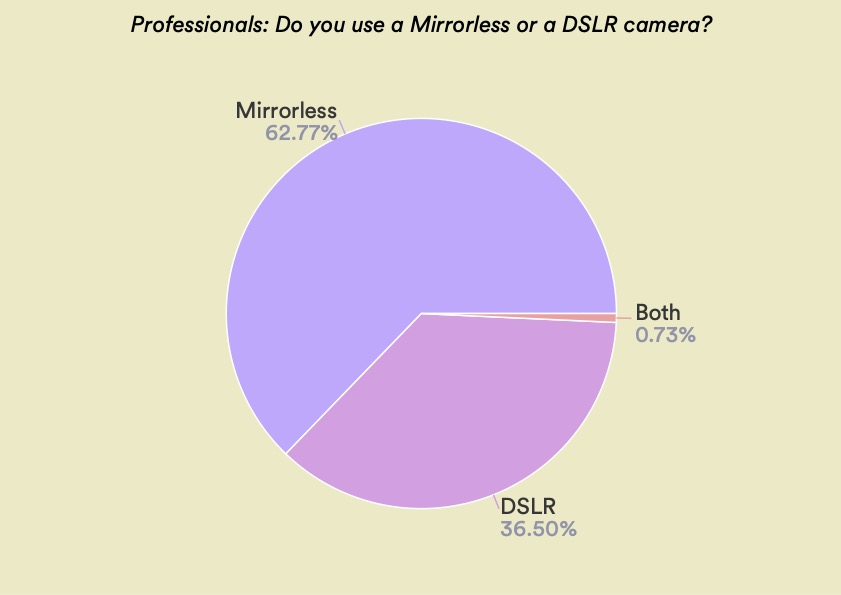
We found that approximately 63% of professionals use a mirrorless camera and 36% use a DSLR. Only 1% use a combination of both:
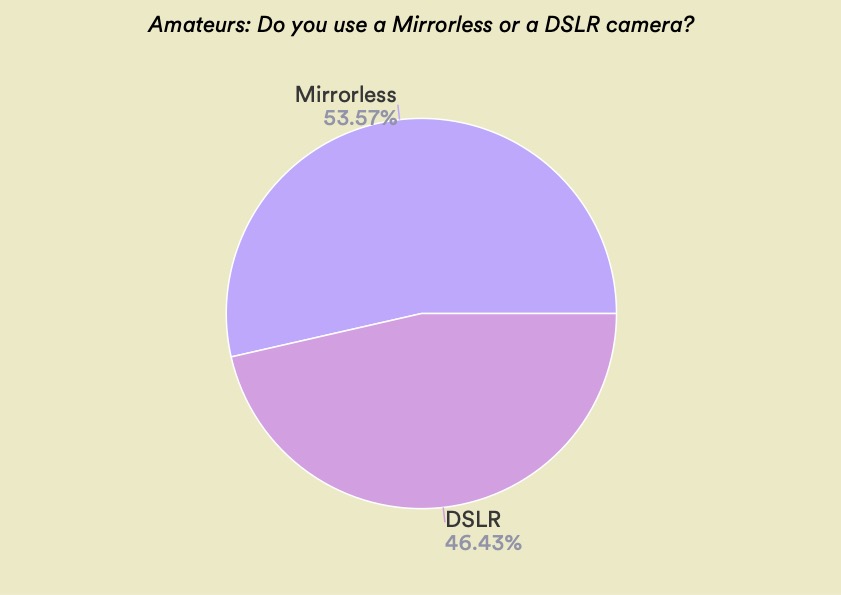
As for amateur photographers, approximately 54% use a mirrorless camera and ~46% use a DSLR:
This confirmed our expectations, with the mirrorless format being more popular than DSLRs.
However, the use of DSLRs is still common among both amateur and professional photographers.
(See also: What is the best camera for professional photography?)
Nikon is the Most Popular Brand of Camera for Professional Photographers
Out of all the major camera brands, Nikon is the most popular among professionals with approximately 31% of respondents shooting predominantly with a Nikon camera.
The second most popular brand was Canon at 29%, followed by Sony (~20%) and Fujifilm (~12%) – see the differences between Sony and Fujifilm.
After this, the usage among professionals of other camera brands dropped significantly:
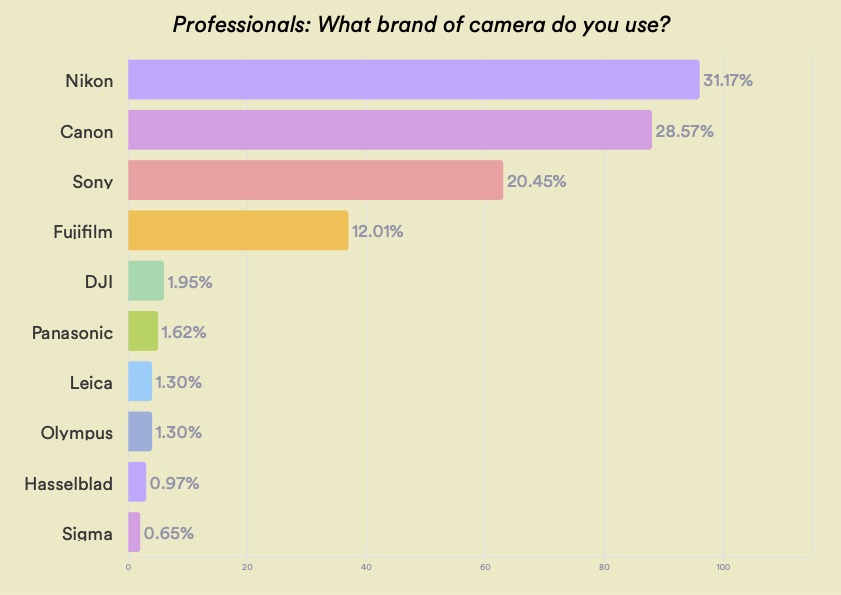
DJI was presumably higher than other camera brands since professional photographers use drones in conjunction with their cameras.
Leica and Hasselblad produce cameras that are much more expensive than other camera brands, so it was no surprise to see them lower in the rankings.
Sigma, with its limited offering of niche cameras, was also expected to be low in ownership among professionals.
We were expecting Canon to be the most commonly used brand by professional photographers above Nikon although the difference is not significant enough to draw conclusions.
As for the top 3 spots, Nikon, Canon, and Sony all produce full-frame cameras, the choice of pros.
Fujifilm, however, only produces APS-C format and medium-format cameras.
Panasonic and Olympus favour the micro-four-thirds sensor, which, while offering some advantages, is a far less popular choice for professionals due to the limitations of the sensor size (notably, poorer high ISO performance when compared to a larger sensor).
One can assume that the dominance of Nikon, Canon, and Sony among professionals is due to the selection of full-frame cameras, undoubtedly the most common camera sensor format in use by pros.
Canon is the Most Popular Brand of Camera for Amateur Photographers
Among amateur photographer respondents, Canon was the most popular camera brand (27.5%).
Nikon (~26%) was a close second, followed by Sony and Fujifilm:
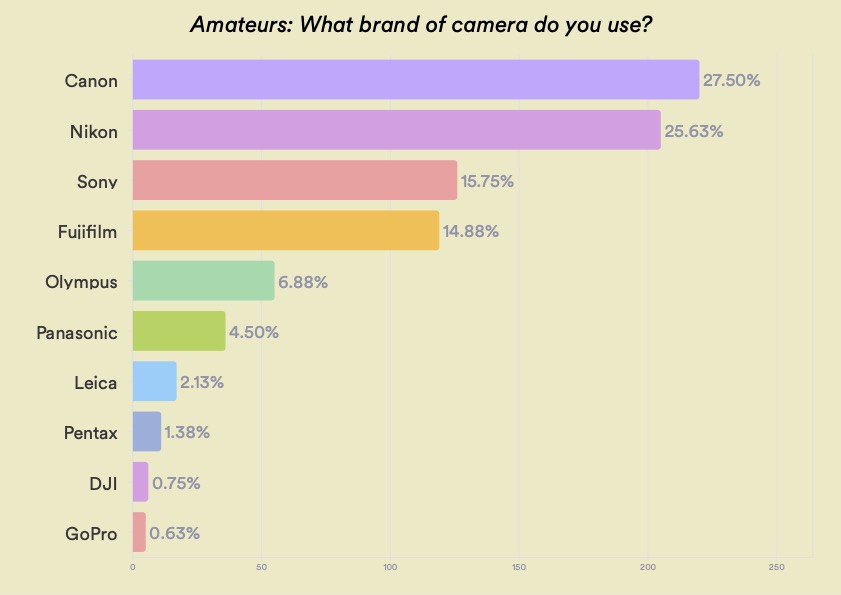
Again, the difference between the top 2 spots was not significant enough to draw any major conclusion.
The same can be said for the 3rd and 4th spots, with the popularity of Sony and Fujifilm below Canon and Nikon being the expected outcome.
The percentage of respondents who own a Leica camera (2%) was an interesting outcome.
This shows that a small percentage of photographers that don't earn an income via their photography are still inclined to invest in expensive camera brands.
Micro-four-sensor cameras and lenses are less expensive than other (larger) formats of sensor, which may explain the greater proportion of Olympus (~7%) and Panasonic (~4.5%) users among amateur photographers than professionals.
Also, the need for better high-ISO performance (offered by a bigger sensor) is arguably less essential among non-pros.
The Sony a7 III is the Most Popular Camera for Professionals
Among professional photographers, the Sony Alpha a7 III full-frame mirrorless camera is most commonly used (~7%).
The Canon EOS R6 full-frame mirrorless camera is the second most commonly used (~5%):
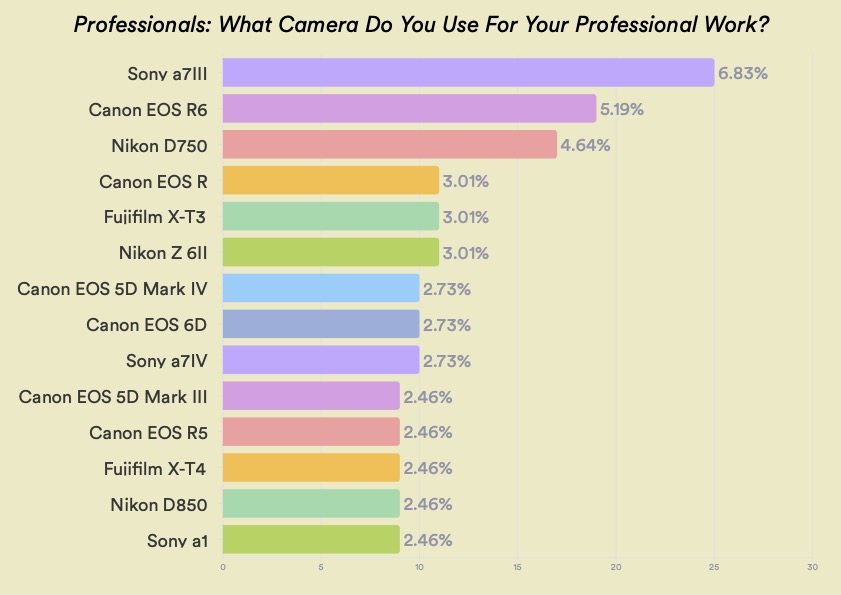
(Limited to top 15 responses.)
Despite being over 4 years old, the Sony a7 III is still enormously popular among professional photographers.
Interestingly, its successor (the Sony a7 IV, which was released in December 2021) appears much further down the list (~3%).
Last year, the Sony a7 III was our pick as the best mirrorless camera. (This year, we chose the Sony a7 IV.)
Anecdotally, I know several professional photographers who see no need to upgrade from the (already excellent) Sony a7 III to the newer model.
(I shoot professionally with both the a7 III and a7 IV and can appreciate the advantages of both models.)
The Canon EOS R6 is another hugely popular camera, especially among wedding photographers.
It's surprising to see the Nikon D750 full-frame DSLR in 3rd place, with approximately 5% of respondents still using this 8-year-old camera.
Widely touted as one of the best DSLR cameras ever produced, the D750 was especially popular among wedding photographers due to its impressive high-ISO performance and articulating screen (rare at the time for a full-frame camera).
In 4th place, the APS-C sensor Fujifilm X-T3 (released in September 2018) is another camera that was placed above its successor, the Fujifilm X-T4.
Fujifilm cameras have a cult-like following due largely to their film-camera aesthetics, film-simulation presets, and excellent image quality.
Fujifilm lenses are more affordable than full-frame equivalents, which may be another reason for the popularity of the X-Series cameras.
The Sony a7 III is the Most Popular Camera for Professionals for Personal Photography
This was a part of the survey conducted for my own personal interest.
As a professional photographer who owns several cameras, I prefer to use different cameras for my personal photography (mostly pictures of family members) vs any paid (professional) work.
I wanted to see if the same was true for other professionals:

(Limited to top 15 responses.)
When comparing the two sets of results, it's clear that many professionals also prefer to separate their ‘personal' camera from their ‘work' camera.
However, the Sony a7 III is still the most popular camera (~4%), which indicates that perhaps professionals are using the same camera for both paid and personal photography.
A ‘non-work' camera is something that can be less functional but is perhaps more pleasurable to use, be that in its simplicity, some aesthetic value or the even just the diminished size/weight of the camera body.
Some professionals may also prefer for their ‘personal-use' camera to be more challenging to use than their ‘work camera ‘- an analogue (film) camera, for example.
(Incidentally, there were no film cameras in use by professionals who responded to the survey.)
The cameras used by professional photographers for their personal photography ranged from full-frame and APS-C sensor mirrorless cameras (Sony a7 III, Fujifilm X-T3) to full-frame and APS-C sensor DSLRs (Nikon D850, Nikon D7100).
The 8-year-old APS-C sensor Sony a6000 mirrorless camera also made a surprise appearance.
The Fujifilm X-T3 is the Most Popular Camera for Amateurs
Released back in September 2018, the APS-C sensor Fujifilm X-T3 mirrorless camera is most popular among amateur photographers (~4% of respondents).
In second place (~3%), the full-frame Sony a7 III mirrorless camera appears again.
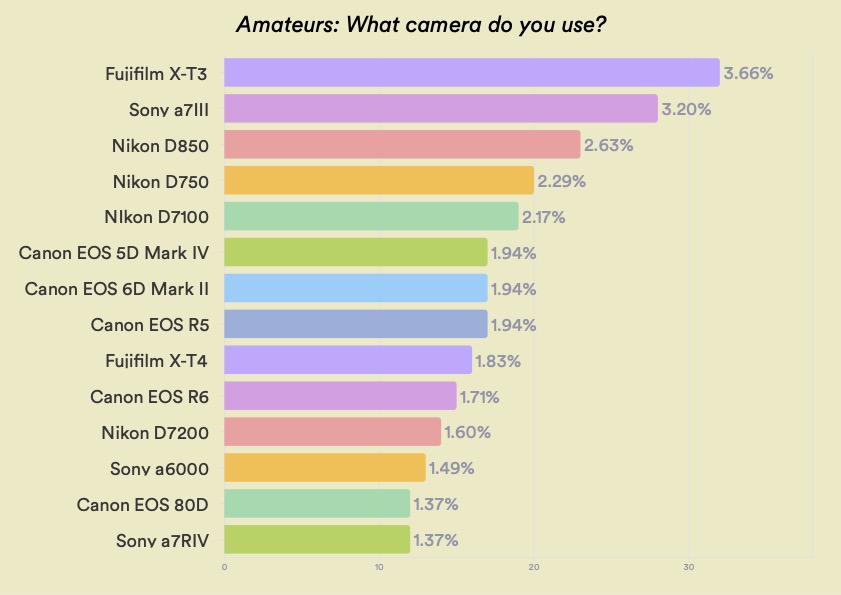
(Limited to top 15 responses.)
At over US$2,700 and built for the rigours of professional photography, the Nikon D850 full-frame DSLR was a surprise at position 3 (~3%).
Interestingly, the 8-year-old Nikon D750 appears in 4th place, belying its age.
In 5th place, the APS-C sensor Nikon D7100 DSLR camera shows relatively strong popularity too.
Overall, it's impressive that an APS-C sensor camera is placed above all the other full-frame models, giving an indication of the strength of the Fujifilm X-trans sensor.
Professionals use Mirrorless Cameras Because They Are Smaller & Lighter (Than DSLRs)
Despite the fact that some modern full-frame mirrorless cameras are actually similar in size and weight to DSLRs, approximately 20% of pros still choose mirrorless bodies based on their smaller dimensions and weight.
The next most common reason (~17%) for professional photographers using mirrorless cameras is that they have better autofocus performance than DSLRs:

Silent shooting (~12%) is important for professionals to remain discrete – for example, wedding photographers who need a silent camera during ceremonies.
In-body stabilization will always be much better in a mirrorless camera body than in a DSLR, so this was another common response (~12%) in our survey.
Around 10% of pro photographers prefer using an EVF over an OVF, presumably due to the instant feedback of any exposure adjustments.
Mirrorless cameras are also better for shooting video, (although certain DSLR models are no slouch in this regard), so seeing this response (~7%) was no surprise.
The availability of certain mirrorless-only lenses came in at ~7%, which was an interesting one, since there are far fewer mirrorless-specific camera lenses than those made for DSLRs.
However, certain lenses are only available for mirrorless camera bodies (e.g. Canon RF 24-70mm f/2). In addition, you can easily adapt lenses for use on mirrorless camera bodies.
Overall, these responses support the fact that the Sony a7 III is the most popular mirrorless camera among professional photographers. While other models also excel, the a7 III is known for its compact dimensions, excellent autofocus and in-body stabilization.
Amateurs use Mirrorless Cameras Because They Are Smaller & Lighter (Than DSLRs)
Amateur photographers also seem to favour mirrorless cameras over DSLRs due to their smaller dimensions and weight (~29%).
This was by far the most common response, which shows the importance of owning a compact camera:
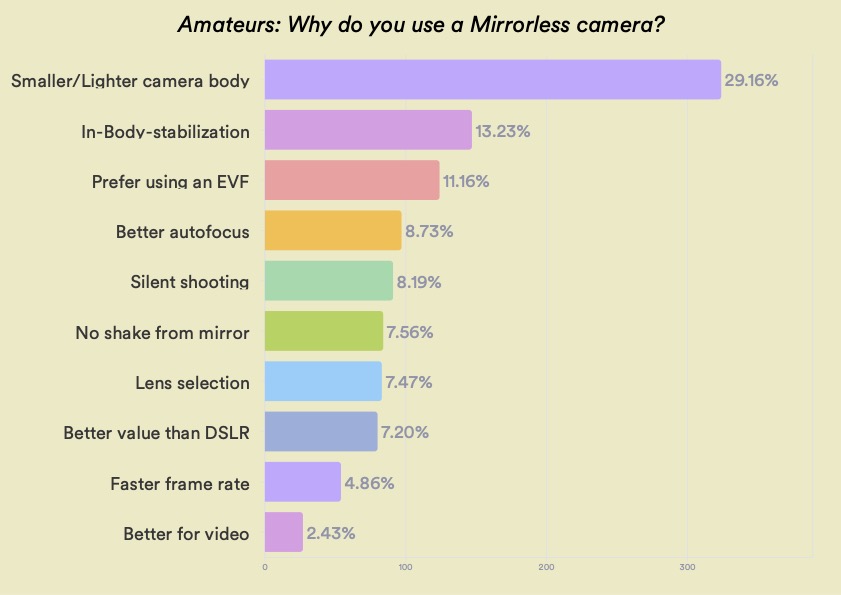
Amateurs also prefer using a camera with superior in-body-stabilization (13%), which gives some indication of usage – IBIS is helpful for low-light shooting, using longer lenses and video capture.
The presence of an EVF on mirrorless cameras, as opposed to an OVF on a DSLR, was the 3rd most common reason (~11%).
EVFs definitely make the photo-taking process easier, while providing real-time information that OVFs cannot.
Professionals use DSLRs Because of the Lens Selection
The 36% of professionals who use a DSLR camera do so because of the superior lens selection (~23%).
There are many more Canon and Nikon lenses made for DSLR camera bodies than for mirrorless camera bodies, for example.
The second most common reason for using DSLRs was one of expense – changing systems is expensive, especially when the photographer is invested heavily into lenses and accessories.
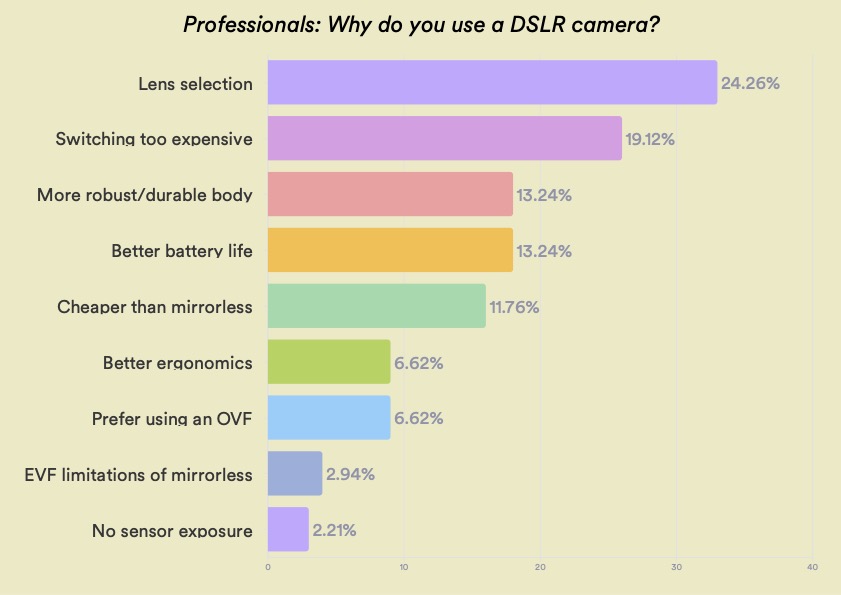
Unsurprisingly, the fact that DSLR camera bodies are more robust and durable than their mirrorless counterparts came in at reason number 3 (~14%).
Flagship DSLR camera bodies such as the Nikon D6 or Canon 1DX Mark III are known for their indestructibility and longevity of shutter life.
‘Better battery life' was also no surprise (~14%) as one of the key reasons for choosing a DSLR, although the batteries in the latest mirrorless cameras can survive much longer than earlier models.
DSLRs are also on the whole cheaper than mirrorless cameras, although based on the different technology and features involved it isn't an apples-to-apples comparison.
It's also worth noting that there are many more affordable lenses available for DSLR cameras than there are for mirrorless cameras – the classic ‘nifty-fifty' Nikon/Canon 50mm f/1.8, for example.
The ergonimics of mirrorless cameras are undeniably worse than those of a DSLR (largely due to most brands' insistence to keep producing smaller bodies), but there's been an improvement with recent releases (notably the Canon R-series, Nikon Z-series and Sony a7 IV, with its deeper grip).
Amateurs use DSLRs Because of the Lens Selection
Approximately 25% of amateur photographers who own a DSLR, do so because of the superior lens selection when compared to the current mirrorless camera offering.
There are many more Nikon and Canon lenses made for DSLR camera bodies than there are for mirrorless camera bodies, for example.
Also, switching from DSLR to mirrorless is an expense that ~20% of amateurs would prefer not to pay.
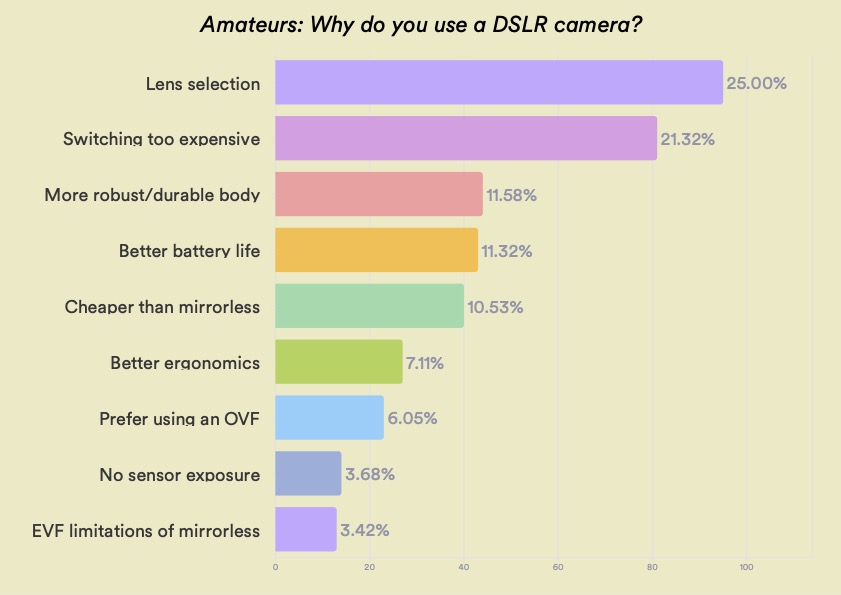
Battery life and robustness of the DSLR camera body came in at joint 3rd spot (~12%), with the expense of mirrorless cameras in 5th position (~10%)
Interestingly, approximately 6% of amateur photographers actually prefer using an OVF to an EVF.
Reasons for this may include the ‘realness' factor of using an OVF, the fact that an EVF can be difficult to adjust to for people with glasses, or simply that the joy of ‘pure' photography can feel diminished by what is essentially a tiny computer screen.
It's also interesting to note that some amateur photographers (~4%) value the fact that the mirror in a DSLR helps to prevent needless sensor exposure.
(Some mirrorless cameras such as the Canon R and Sony a7 IV have actually solved this issue with an automatic sensor cover, although this is not a commonly touted key feature.)
Final Notes on How the Survey was Conducted
After creating the survey using JotForm, we shared the link in various places:
- Facebook Groups
- Shotkit email subscribers
- Shotkit Facebook followers
We took care to select ‘neutral' photographer groups that wouldn't skew the results with specific brand loyalty, etc.
i.e. we didn't share a link to the survey in the Fuji X-Photography Facebook Group!

Obviously, there are various limitations and assumptions when conducting a survey of this type on a relatively small scale.
Next time, for example, we will collect data from a larger number of photographers and devise a way to display more responses in a concise format.
We will also go more in-depth regarding the various reasons photographers choose one camera over the other.
If you have any suggestions which may help improve future surveys, please leave them in the comments section below.
You should also check out our article on camera industry stats and the results of our survey on what photo editing software photographers use.

Check out these 8 essential tools to help you succeed as a professional photographer.
Includes limited-time discounts.

Mark Condon is a British wedding photographer and editor of Shotkit. When he’s not taking photos or reviewing the latest camera gear and software, Mark can be found cycling around the northern rivers.
25 Comments
Leave a Comment
👋 WELCOME TO SHOTKIT!
🔥 Popular NOW:

Great survey idea. I agree with the commenter that pointed out the stats don’t make sense.
For example with “camera used” by pros numbers do not correspond to the “manufacturer used” whatsoever. So there’s major flaws in this.
Nikon at 31% of share among pros yet only two specific cameras mentioned for total of 8%? Huh?
Meanwhile Canon at 29% among pros and five different cameras totaling 16%.
What are you guys doing?
It sounds like you’re analyzing a survey and are frustrated with inconsistencies in the data.
Your observations highlight a key issue: the disconnect between aggregate numbers (e.g., “manufacturer used”) and the breakdown of specific items (e.g., “camera used”).
This could stem from:
Incomplete Data:
The survey might not have included all cameras in the breakdown, leading to an underrepresentation of some brands.
Sampling Bias:
If the survey didn’t reach a balanced demographic, some brands might be over- or underrepresented.
Misclassification:
Respondents might have listed their primary manufacturer but included older, less common models not explicitly tallied.
Flawed Methodology:
If the survey design or data aggregation isn’t rigorous, inconsistencies like these are likely.
A better approach would be ensuring transparency in the methodology, clarifying how data was collected, and providing a full breakdown for alignment between categories.
We will do better next time.
Thanks for the feedback.
I’m surprised it’s only 6% who say they use DSLRs because the prefer the OVF.
Fun read including the comments.
Some very insightful responses but one missing.
So the most popular cameras used by amateurs are $2,000 cameras?
I feel dusted.
Thanks for the detailed analysis. Interestingly, the Nikon data looks much more positive than I normally read in blogs, magazines and see on youtube videos. I think that Nikon can perform well next years …
I agree with others posting here. This survey doesn’t have enough responders to be seriously considered as representative of photographers in general. Also, the camera that you use the most isn’t necessarily the most recently purchased camera. I use my D500 with 80-400 lens more than my D850 with 24-120.
1000 responders is a large sample. If you had 10,000 your results would be the same. The Science of Statistics.
The tiny difference in achievable image quality between the best DSLRs and the best mirrorless cameras, that is made possible by the shorter lens to sensor distance and the removal of a source of vibration does not (at least for me) justify the cost of changing systems. In real life use there is no significant difference. Neither do the new features made possible by using the sensor for focussing and for AI trickery justify a change of system for many of us.
Most camera makers have abandoned DSLRs because the DSLR market is saturated. The only way to sell us more ILC cameras in significant numbers, and at high prices, is to tempt us with new technology that offers a few new capabilities. Those capabilities are very useful to some photographers, but are of no use at all to many others.
THe other pasrt of the sales/marketing strategy is to offer us no new lternatives to m rrorless cameras … i,e by not only ending the development of new DSLRs and lenses for them, but also by ending production of most of their existing DSLR lens line-ups.
Miirrorless technology is not a “game changer”. In no way does the advent of mirrorless cameras compare to the game changing move from film to digital, or to the earlier development of fast and accurate autofocus.
Excellent comments. It’ all about profits for the manufacturers. DSLR’s excell for many situations. But they cost more to manufacture and sell for less, besides being mature technology for years now, so not what the industry wants us to use.
I agree with Jan’s comments. I’ve recently retired from the printing industry after 50 plus years. During that time I bundled my photography services with the print projects that we produced, and my last new system was when Olympus released the OM1 . Since then I’ve only purchased used equipment and I started using digital with the Kodak/Nikon 600 and 700 series of cameras. I was being paid using that equipment when they were ten years old and discontinued. Now I use Nikon and Cannon ten year old bodies, and now I’m an full time amateur.
I started photography with a Nikon D50 in 2005. Then upgraded to a Nikon D700. Then switched to Canon with a 5D Mark II because Nikon couldn’t get their video-quality onto the same level. Eventually I traded my Canon gear for an Olympus PEN, went through various generations until the Pen-F. I shortly tried the Sigma DP and now finally settled with the new Fuji GFX system, which is absolutely amazing.
What I’m trying to say is, the market is constantly changing, and in five years it may look completely different, and five years ago it probably was also completely different. Just go with what suits you. :D
Well lots to say about this “survey” but mostly questions about how the “survey” was conducted (was it over the phone, an online questionnaire or ??), which population of respondents –those owning digital cameras or folks in the street AND what types of digital camera (all digital camera (which include cell phones and others) or only those with ICL?), which geographies were included in the polling (just USA, NA or?), what (if any) validation was undertaken to confirm that those who claimed to be professional were actually earning the majority of their income from photography (the definition used by NPS, Canon and others), AND perhaps the most telling question — why did the role of video/hybrid shooting play such a tiny part of questions / responses.
The links to the survey have all expired and so one cannot delve into the questions asked and any implicit bias/or not.
A survey of 1,000 – is not a bad start but for such a broad subject one would have hoped for more gradation within the shooters of what types of photography they use their cameras to shoot — Lets examine the category “pro” = well what type of pros — outdoor sports, indoor sports, news, studio fashion, runway, headshots, weddings, interiors, RE/Architecture, small product, large product, events, landscape, pap, and …. AND most importantly there is a vast difference in live sports between pros who are employed by bureaus or end-users/distributors and those who are freelance/self-employed who may work for clubs or smaller outlets — the latter have to make the most of the assets they invest in and “tend’ to drive their gear into the ground (D5 users) before upgrading (unless they need the performance). The former — particularly big event shooters tend to use gear owned or rented by their agency and provided with support by the manufacturers (Nikon has a huge team in Doha and at most major sporting events). AND so on.
With over 5 million new Digital ICL cameras sold in 2021/22 and a population of well over 50 million Digital ICLs in use (more likely 200 million) – 1,000 does not seem a large enough population for any findings not to come with very large/wide uncertainty/confidence levels. If one looks at the 28% (280) who self elected to be considered as Professional shooters this is a tiny number to draw any conclusions worthy of posting without heavy caveats. I do not consider the findings to be scientifically relevant — however has each conclusion been properly couched — X% of the 270 respondents from those claiming to be professional stated the used/chose A over B then the presentation would have been far more relevant.
Thanks for the feedback, Andy. Will take this into consideration when we prepare the next one.
I appreciated the work you put into this but I find the results inconsistent and conflicting.
the question “Professionals: What brand of camera do you use?” is 31% Nikon. but the question “Professionals: What Camera Do You Use For Your Professional Work?” seems to contradict that with with none of the camera being “used” matching the Brands the poll takers said they were “using”. In the list of cameras that professionals USED there were actually more Canon cameras listed than Nikon or Sony. After reading and re-reading its seems like more of a Sony promotion piece than anything else. Who knows where the truth is.
This leads be to believe that what was said by British Prime Minister Benjamin Disraeli, “There are three kinds of lies: Lies, Damned Lies, and Statistics” and, the only time I will quote Sarah Palin – “Polls? Nah… they’re for strippers and cross country skiers.”
That said, I’m an amateur and have an older Nikon D700 DLSR and several lenses I’m thinking abut upgrading/replacing but with the Nikon Z series it mean basically replacing everything (yeah, I know there is the ftz and ftz2) so maybe its time for something different. Maybe I’ll just stick to my vintage folder film camera’s and shoot black and white.
Hey Greg, I’m not sure I completely understand your point but I can assure you this isn’t a promotional piece for any camera company.
An egotistical snob wanting attention.
Ansel Adam’s, a renowned and innovative photographer of the 1930s and 1950 , only shot black & white. See his work everywhere, even now.
Please don’t use the “dead technology” term for a technology that is still in use but no longer being improved. My grandma will not have more kids and she will not get healthier but she is not dead. “Dead technology” should mean one no longer used like: “writing with a feather of a goose”, “sending letters by postal pigeons”, “crushing a city wall with a trebuchet”.
Mark,
I think this is a little misleading. I switched from a Canon 5D Mark IV to an R5., The reason I switched was not listed on any of your survey questions. I switched because Canon made it very clear that were no longer going to invest in the further development of DSLR’s like my 5D. If I wanted new features, like the superior “eye” auto-focus available on the R5, and most other mirrorless cameras, I had to go mirrorless. Canon has even come out and said this is their plan.
If you want to be able to take advantage of the new features the camera manufacturers are developing, you have to be using a mirrorless camera. Its that simple. I bought an adapter to be able to use my old lenses and that works pretty well.
I don’t know if there are really any significant advantages that would justify ending development of DSLR’s. MIrroless camera are a bit lighter, I guess. They do not have the vibration from a mirror moving. But neither of those two are deal-breakers or hard to overcome.
I’m sure they are easy to produce as most of the mechanical stuff that moves has been removed. Everything is pretty much all electronic which in this day and age is much easier from a production standpoint. Plus it “juices” up their revenue stream and they essentially force everyone to replace their lenses over time.
I’m not really boring cynical about this. Canon, and the other manufacturers, are businesses and anything they can do to increase their revenue is a good move for them. I would also assume that, over time, the lack of a moving mirror would be one less thing that would be likely to fail, so a mirrorless camera should be more reliable in the long run.
Interesting information! A few questions and comments:
1. How were “amateur” and “professional” defined?
2. How were the “Why do you use mirrorless/DSLR” questions asked? Were the respondents only able to choose one option, or could they choose several?
3. It would be helpful if we could see the original survey so as to understand the precise wording of the questions.
Really appreciate you putting this together – cheers!
Hey Wil – there’s a link to the original survey at the bottom so you can check it out.
Amateur=not earning money via photography.
The most surprising thing about this study is none of the conclusions drawn, but how incredibly far off it is from existing public/published data on market-share from respected industry groups and researchers.
Comparing these results to real-world data does provide some interesting insights as to what segment of the photography market makes up the shotkit readership, though.
The link to the survey was shared in groups that had nothing to do with Shotkit, but I do agree that the results were suprising.
Mark hello,
This was really well done. I wonder if in your analysis comparing it all to published category information would be really interesting to see differences.
Perhaps this could make a great follow up post , or interview some OEM marketing people for their reactions?
For example ;
What are OEM and brand market shares as published by industry?
What is the share of mirrorless versus dslr sales right now?
This would not to be to call into question your data at all but to see what your survey uncovered with 1,000 active photographers vs industry info.
Last suggestion please do this annually to see where these trends move ?
Lance
“Market share” can have little to do with popularity.
Market share measures what is selling, whereas this survey measures what has sold.
Indeed, Mark mentioned the “surprise” of seeing some eight-year-old cameras among the results. Those cameras would not show up *at all* in a market-share survey! (Indeed, they are probably discontinued.)
Take my case. I once made a living from photography, but today, I would have to classify myself as “amateur.” I have some 50+ cameras and lenses in my collection. Some see a lot of use; some sit behind glass. But I rarely buy new, these days. I just got an OMDS OM-1 with the pro “kit” lens, the outstanding 12-60mm ƒ/2.8. But other than that, I’ve not purchased “new” in five years, thus hardly show up in “marks share” surveys.
I often shoot an Olympus PEN F, E-M1 Mark II, and even an E-3 and E-300 — all of these have been discontinued, some, by over a decade!
So I would submit that, rather than this survey being somehow anomalous to ShotKit readers, more closely fits what people are *using*, rather than what people are *buying*.